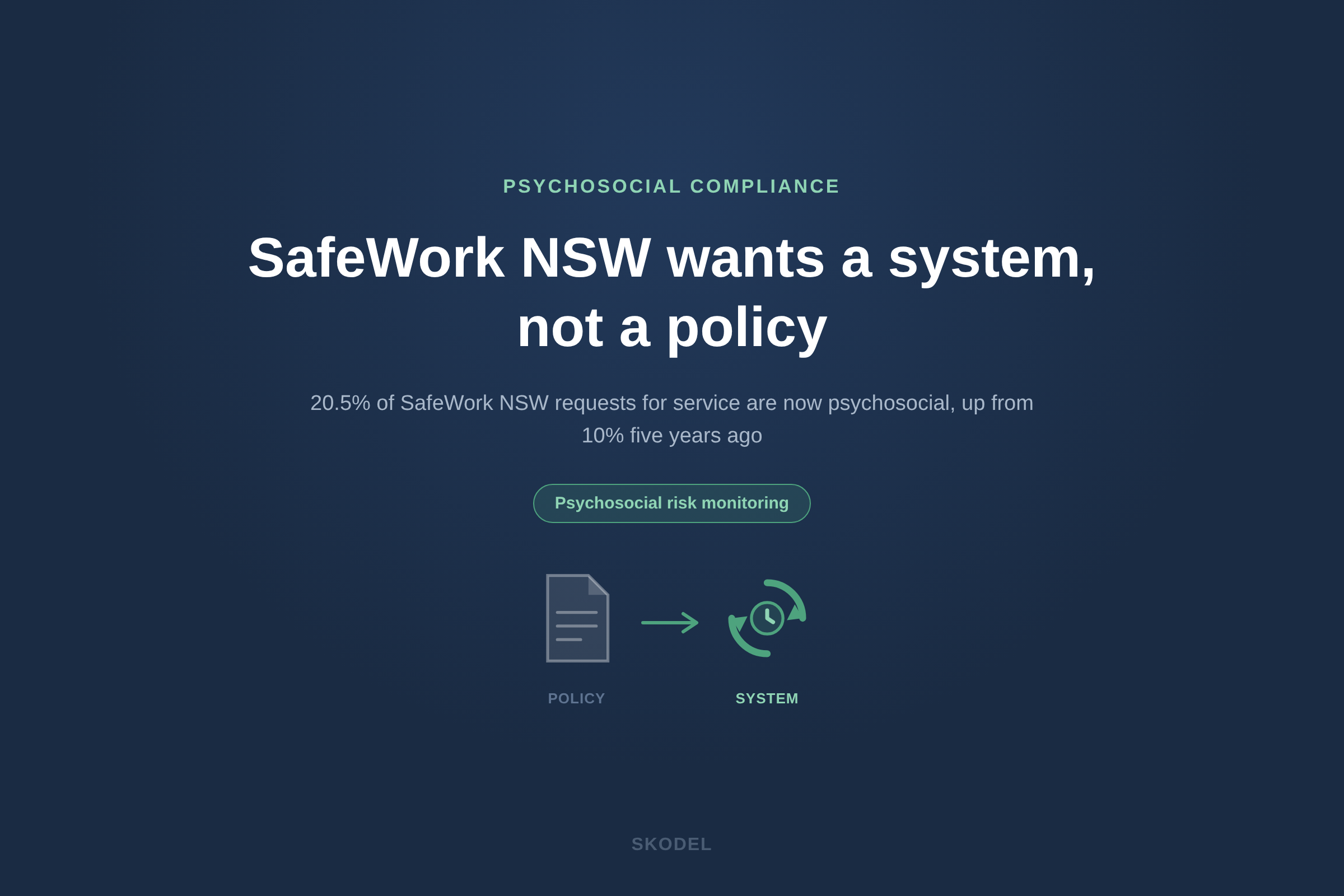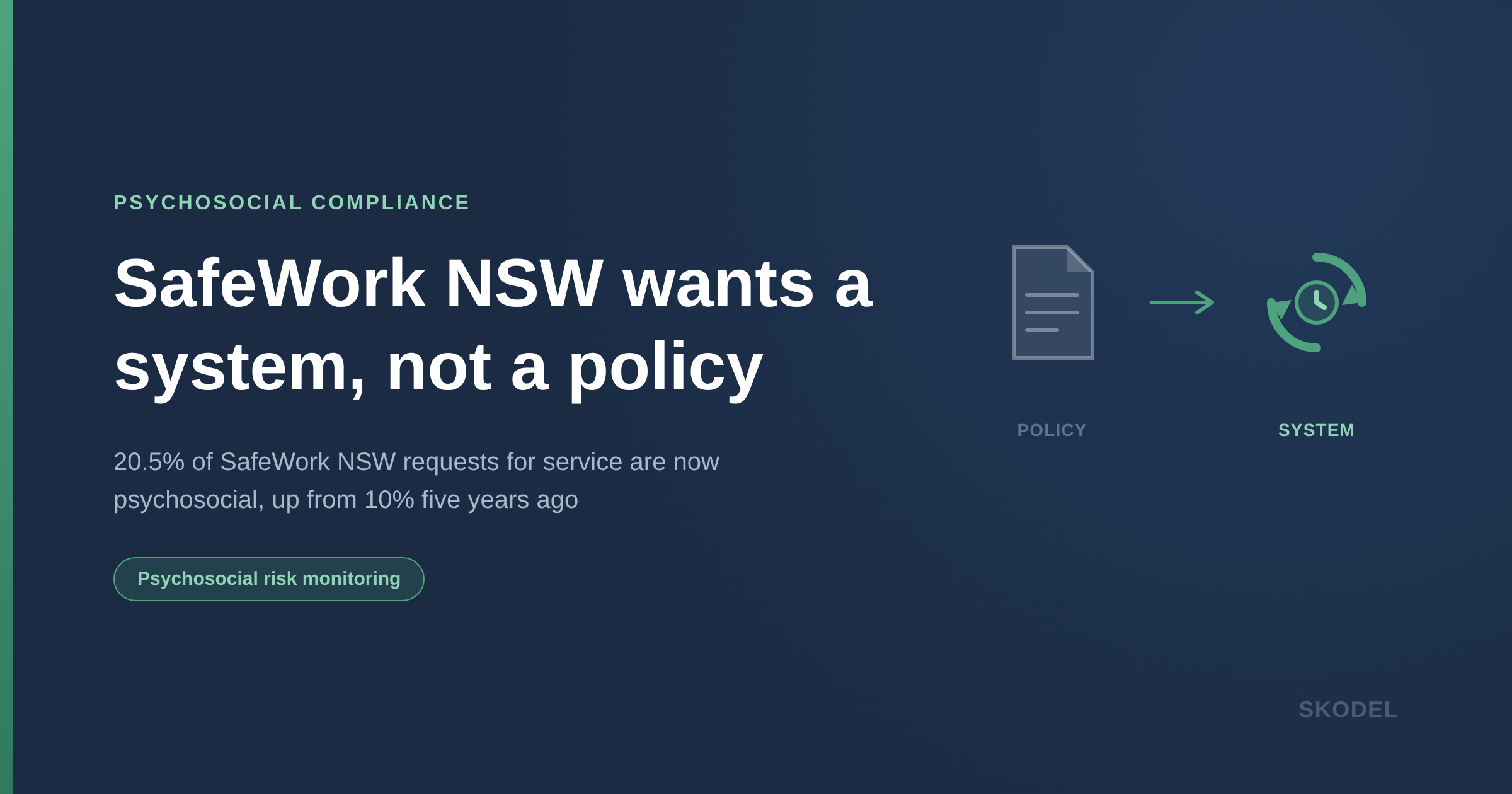
SafeWork NSW received 3,145 requests for service about psychosocial harm in the 2025-26 financial year. That is 20.5 per cent of everything the regulator handles, up from 10 per cent five years ago. The share has doubled while the rest of its caseload has not moved anywhere near that fast.
SafeWork NSW has kept psychosocial risk as a named priority for a second year running, alongside falls from height and hazardous substances. That continuity is deliberate. It signals this is not a one off compliance push businesses can wait out.
A request for service is a worker, a union, or a health and safety representative asking the regulator to look at something. It is not a prosecution and it is not proof a business did anything wrong. But a share doubling in five years points at something structural, not a one off spike. More people feel they need to go outside their own workplace to be heard.
A policy is not a system
SafeWork NSW's own 2025-26 Regulatory Statement is specific about what it wants to see businesses actually do. Not a policy sitting on a shelf, but businesses that consult workers properly, identify risks early, and manage them with controls that are reviewed on an ongoing basis, rather than written once and left alone.
The sexual harassment data in the same statement makes the point hard to avoid. One in three Australian workers report being sexually harassed at work in the past five years, costing the economy an estimated 2.6 billion dollars a year in lost productivity. That is not a problem one policy update fixes. It needs an ongoing system for knowing whether harassment is actually going down in a given workplace, not a complaints process that only switches on once something has already happened.
The step most businesses skip
The WHS Regulation already sets out the cycle every business is supposed to be running. Identify the hazard. Assess the risk. Apply a control. Review whether it worked. Most businesses we talk to have a system for the first two steps. A risk register exists, a survey has been run once. Far fewer have a system for the fourth.
This also matters for how a business is judged after the fact. What a business knew, or ought to have known, is one of the factors regulators weigh when deciding whether enough was done. A dated record showing hazards were actually monitored over time is evidence a system was running. A policy document with no activity behind it is not.
The cost of skipping that step shows up in how people recover. Only around 60 per cent of workers with an accepted psychological injury claim return to work within the first year. Four in ten are still off work twelve months later. A control nobody checked is a control nobody actually knows is working, and the workers compensation numbers are the lagging proof of that.
What an actual system looks like
SafeWork NSW has also said this year it wants to help small and medium businesses without a dedicated WHS team build this capability, not just assume only large employers need to monitor psychosocial risk properly. A working system does not require a big team or complicated software. In practice it means
- A baseline measurement before a control goes in, so there is something to compare against later
- A recheck on a schedule, not only when someone complains
- Reading the score next to what people actually wrote in their own words, not the number by itself
- A dated record showing a hazard was raised, what was done about it, and whether the score moved afterwards
None of this requires guessing what SafeWork NSW wants. The regulator has said it plainly. The gap left for most NSW businesses is not awareness anymore. It is whether they actually have a system, not just a policy that says they should.
Want to see what that system looks like for your own workplace? Reach out to info@skodel.com.