
The Workforce Strain Index (WSI)
Skodel’s Workforce Strain Index provides a practical way to identify, prioritise, and monitor sustained psychosocial risk across a workforce.
What is the Workforce Strain Index?
A risk prioritisation tool that measures sustained psychosocial strain across your workforce. Designed for clarity and sustained usability, enabling you to identify priorities, benchmark performance, and track control effectiveness.
Clear and interpretable
No complex reports or ambiguous findings. The WSI gives you clarity on what matters most
Low burden to use
Designed for sustained engagement over time, not one-off surveys that fade away
Action-ready insights
Know exactly where to focus your efforts and resources for maximum impact
Common challenges with psychosocial surveys
Organisations often face barriers to effective psychosocial risk management:
Complex interpretation
Reports that require significant expertise to understand and translate into action
Declining participation
Lengthy surveys that reduce engagement and response rates over time
Unclear priorities
Difficulty identifying where to focus efforts and allocate resources
How the WSI identifies sustained strain
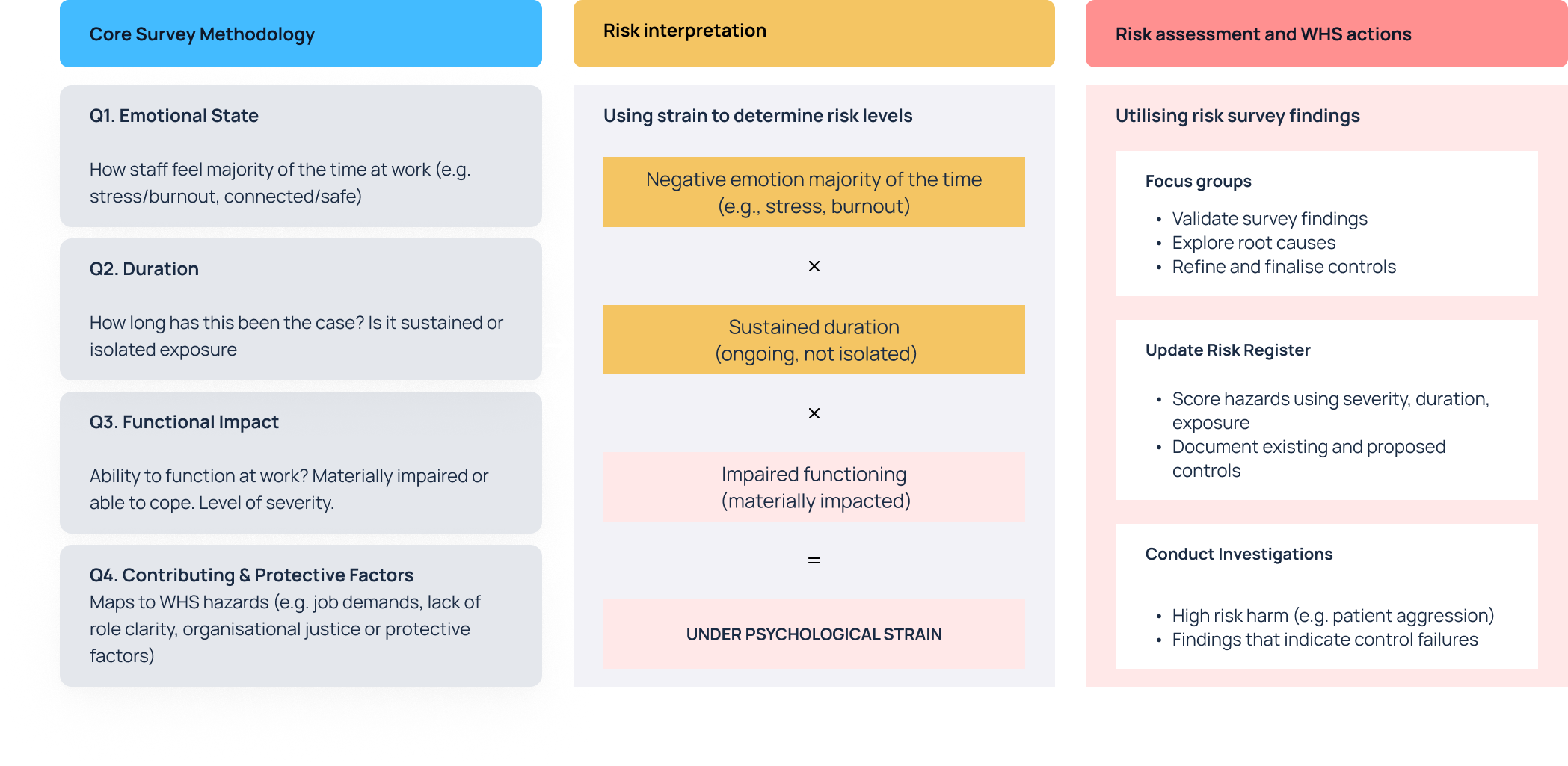
A clear, brief approach that focuses on meaningful risk rather than transient pressures. Workers experiencing sustained strain report all three indicators simultaneously.
Negative emotional state
Feeling stressed or burnt out at work most of the time
Functional impact
This experience affects their ability to function or perform their role
Sustained duration
The experience has been ongoing rather than temporary or isolated
When related indicators align, confidence in risk identification increases. This helps organisations focus on meaningful risk rather than normal day-to-day pressures, consistent with contemporary occupational psychology and psychosocial risk research.
Designed for sustained usability
Addressing the key challenges that limit effective psychosocial risk management
Low burden to interpret and use
The WSI provides immediately interpretable insights that maintain workforce engagement over time. Built on recent research for shorter, more precise psychosocial assessment.
Clear prioritisation
Instantly see which areas need attention
Maintained engagement
2-5 minute surveys that workers complete year after year
Actionable insights
The right level of detail to drive targeted change
Externally evaluated
Independently reviewed for psychological soundness and WHS alignment
Externally evaluated and evidence-informed
Independently reviewed by leading psychological and WHS experts
15,000+
Workforce survey responses analysed to refine the methodology
2-5 min
Survey completion time, critical for sustained engagement
WHS aligned
Identifies workplace risks contributing to strain for effective psychosocial risk assessment
"The WSI functions as a risk prioritisation tool, not a clinical score. It supports comparison across groups and time, and highlights compounding psychosocial hazards. The conceptual logic of the Index is appropriate for its stated purpose."
Andrew Fuller, Psychologist and Advisor to Skodel
Practical applications
How leading organisations use the WSI to manage psychosocial risk
Support psychosocial risk assessment process
WSI supports robust psychosocial risk assessments. It helps identify high levels of psychosocial strain and the key workplace factors (e.g. job design, resources or social) to enable effective risk assessment.
Department comparison
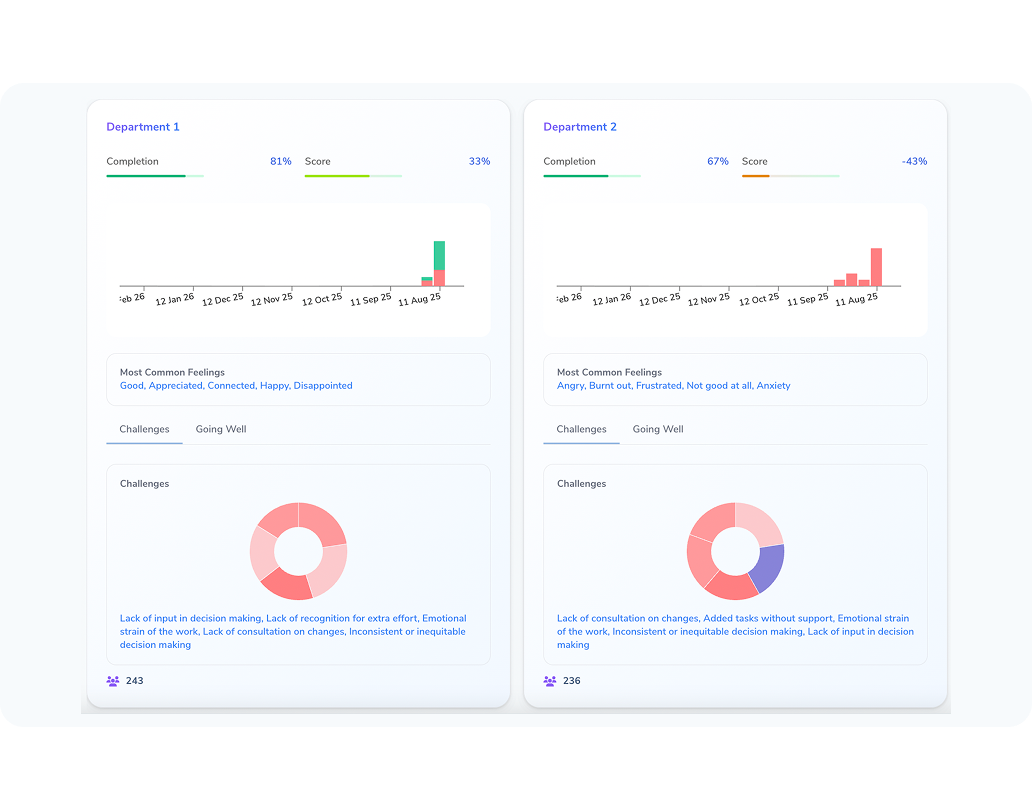
Identify which teams or departments are experiencing higher strain and require targeted consultation and controls. Compare Workforce Strain scores across your organisation to allocate resources where they're needed most.
Track control effectiveness
Monitor WSI over time to measure whether your psychosocial risk controls are reducing workforce strain. Demonstrate continuous improvement and data-informed decision-making to leaders and regulators.

Read the full evaluation
Download Skodel's independent evaluation paper to understand the psychological soundness, WHS alignment, and practical utility of the WSI methodology