

The same five factor test you already use for physical hazards. Here's how it plays out when the hazard is psychological.
Section 18 of the WHS Act doesn't have a separate test for psychosocial hazards. It's the same five factors used for a trip hazard or an unguarded machine.
What changes is how each factor actually gets applied when the hazard is psychological rather than physical. Many businesses say this is where they get stuck. The test itself doesn't change, but each factor gets harder to interpret once the hazard is psychological, where the evidence is less visible and the harm is harder to point to.
In December 2025 the NSW Local Court convicted the Department of Defence after a RAAF technician died in 2020, following four performance management Work Plans in six months. Defence pleaded guilty and was fined $188,000, the first Commonwealth employer convicted under federal WHS law for failing to manage psychosocial risk. There was no contested hearing weighing the five factors against each other, but they're still the right lens for what Defence admitted to. Examining the Department of Defence case, here's how each one applies.
1. How likely was the hazard
Courts look for pattern, not a one off. Four Work Plans in six months is repeated exposure, and repetition is what made likelihood easy to establish.
2. How much harm could it cause
This draws on existing hazard research, not guesswork about this specific case. Performance management is part of almost every workplace. It becomes a hazard when it isn't run well, here showing up mainly as poor organisational justice, procedural fairness in how the process was run, and poor support, no referral pathway when someone starts struggling. Defence didn't need this harm profile proven from scratch. The link between poorly run performance management and those hazards is already established in existing guidance and research.
3. What the employer knew, or ought to have known
This is the factor employers get wrong most often. It isn't tested against what one supervisor understood on the day. It's tested against what guidance, codes of practice and the employer's own policies already said. Defence had psychosocial policies on paper, and Comcare's own guidance had already linked poorly run performance management to hazards like poor organisational justice and poor support for years. That's constructive knowledge, and it existed whether or not any individual supervisor had been trained to act on it.
Ignorance isn't a defence here. A PCBU doesn't get to argue it genuinely didn't know, if a reasonable business in its position ought to have known. That's what makes consultation so central to this factor rather than a separate box ticking exercise. Consultation is one of the main ways a business actually finds out what's going on in its own workplace, so a business that hasn't been consulting its people has no record of trying to find out what it should have known. That absence doesn't help it. It weakens its position, because it removes the one thing that could show it took reasonable steps to know.
4. What controls were available
Courts test this against what's already in use elsewhere, not hypothetical measures. Training supervisors to recognise the hazard and refer workers for support were both standard, already practiced controls sitting at Defence's fingertips. This is the one Defence actually admitted to falling down on. The policy existed. The training didn't happen.
5. Whether the cost was grossly disproportionate
This is the only factor that can excuse inaction, and the bar is high. Training supervisors and setting up a referral pathway cost little next to the harm at stake. No basis to call that disproportionate.
Defence pleaded guilty, so none of this went to a contested hearing. There's no judgment weighing one factor against the other four. What's on the record is the breach Defence actually admitted to, failing to train supervisors on the Work Plan procedure. That's a controls failure. It only existed because the knowledge was already there, a policy on paper that nobody made sure supervisors used. A policy that exists but isn't trained on, checked or acted on doesn't satisfy factor three. It just removes any excuse on factor four.
What that evidence actually looks like
Skodel's reporting maps onto the same factors.
Factors 1 and 2, likelihood and degree of harm
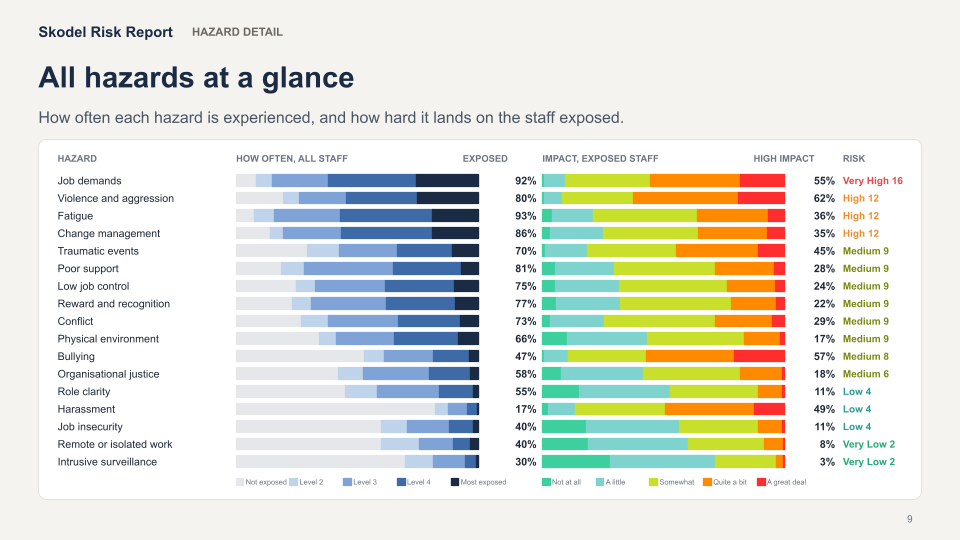
Frequency of exposure and degree of harm across all 17 hazards, in one dated view. Frequency supports likelihood. Degree of harm is its own measure, how hard it lands on the people exposed.
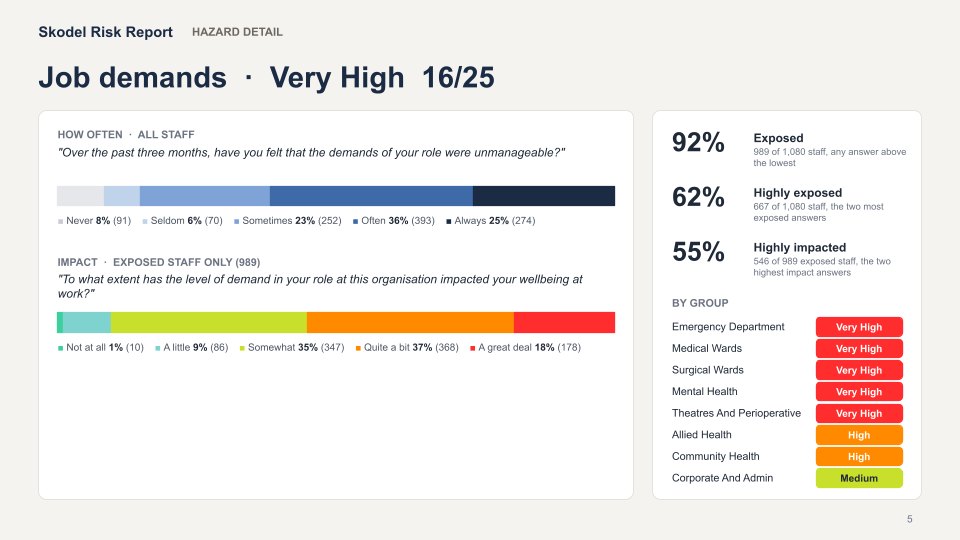
The same two measures drilled into a single hazard. That's the level of detail a specific case gets tested against.
Factor 3, what you knew or ought to have known
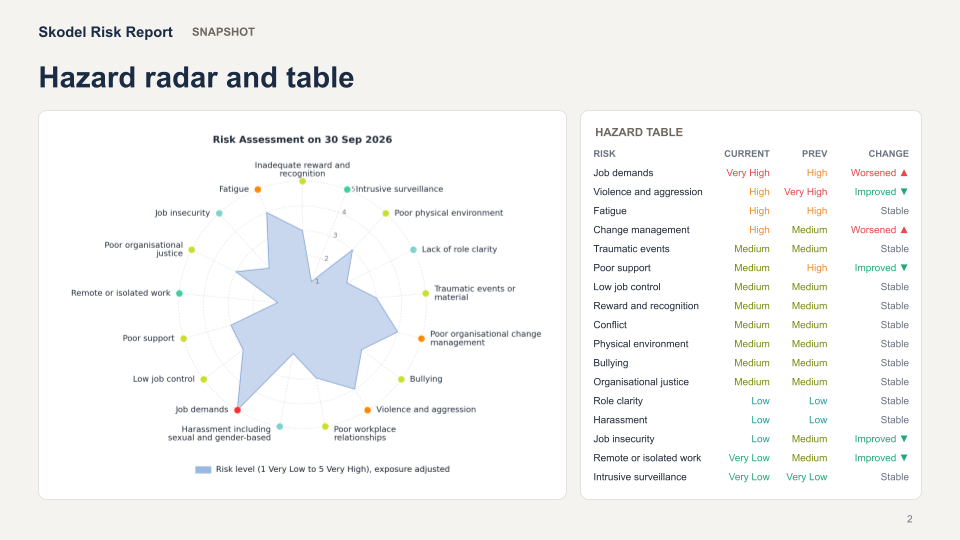
The hazard radar scores all 17 recognised hazards at once, dated. That's evidence of what the business could see, not what one supervisor happened to notice.
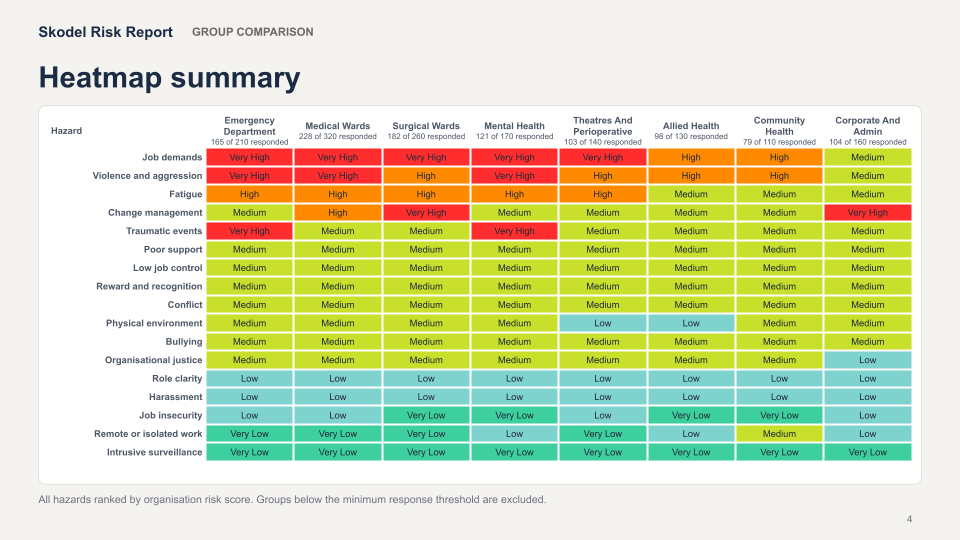
The heatmap breaks that same data down by team, so you can show you had visibility into exactly where a hazard was concentrated, not just that a business wide policy existed on paper.
Factor 4, available controls
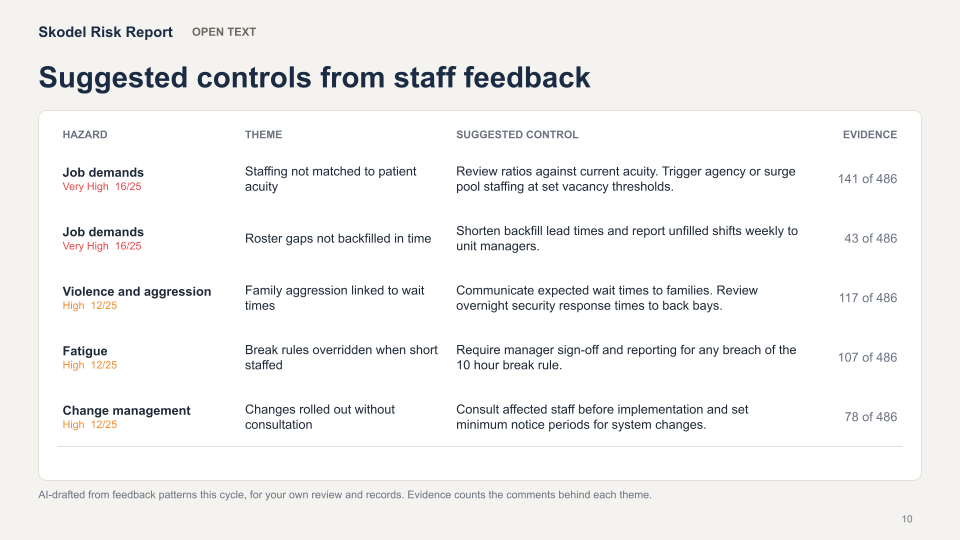
A dated record of the controls in place for a hazard, and the evidence behind each one. That's what shows a control is a response to what's actually being raised, not a guess.
Skodel's reporting is designed to help you evidence this, not after an incident, but as a matter of course.
Planning for 2027? Reach out to info@skodel.com.

