
.png)
Understanding the Workforce Strain Index (WSI)
The Workforce Strain Index (WSI) is designed to help organisations identify sustained psychosocial strain in their workforce - not momentary pressure, bad days, or isolated stressors. The WSI has been independently evaluated by external clinical psychologists and WHS regulators and refined through analysis of more than 15,000 workforce survey responses.
It provides a clear way to understand where strain may be becoming a work health and safety risk, so leaders can prioritise consultation and action.
The WSI is not a clinical measure and is not intended to diagnose mental health conditions. Its purpose is risk identification, prioritisation, and prevention in line with WHS obligations
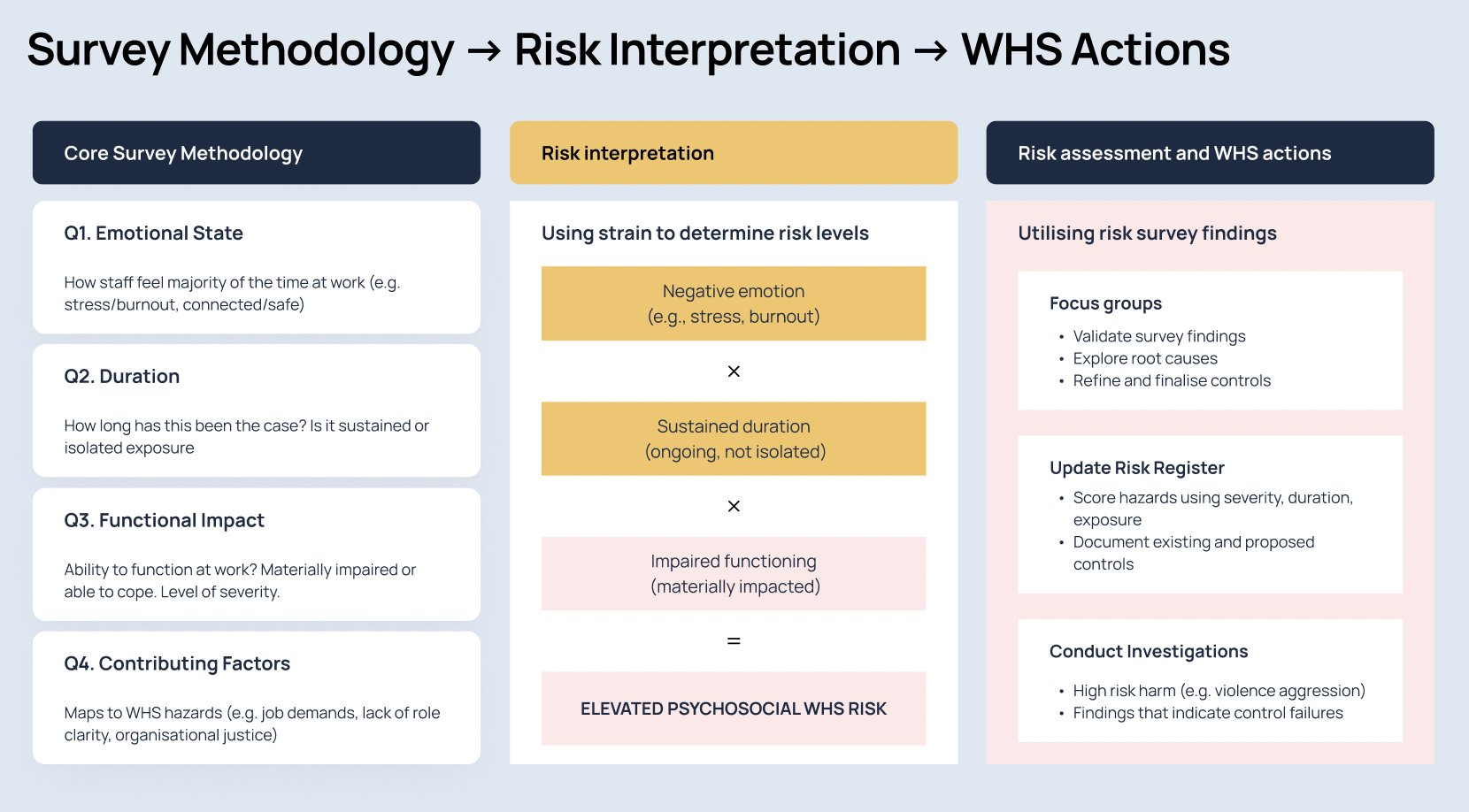
What the Workforce Strain Index Measures
Psychosocial risk is rarely captured by a single question. Feeling stressed once is different from feeling stressed most of the time, for a long period, and struggling to function because of it.
The WSI brings together three critical leading indicators of psychological injury to distinguish between normal, short-term pressure and sustained strain that may require action.
The Three WSI Questions
To be counted in the Workforce Strain Index, a respondent must complete all three of the following questions:
1. How do you feel at work most of the time?
This question captures a person’s predominant emotional state at work, focusing on how they feel for the majority of their working time, not just occasionally.
This helps identify early signals of potential strain, while recognising that emotions alone don’t always indicate risk.
2. How long has this been the case?
Duration matters.
This question helps distinguish:
- short-term or situational pressure, from
- ongoing or sustained experiences that can compound over time.
Research consistently shows that chronic exposure, rather than stress alone, increases psychosocial risk.
3. How well are you able to function and perform your role?
This question focuses on impact, asking whether a person’s experience is affecting their ability to:
- perform effectively,
- cope with work demands,
- or function as they normally would.
When strain begins to interfere with functioning, it becomes a clear work health and safety concern.
How Someone Is Counted as “Under Strain”
A respondent is only counted as “Under Strain” in the Workforce Strain Index when all three conditions are present:
- they report feeling in a negative state at work most of the time
- the experience has been ongoing (not isolated or short-term)
- it is affecting their ability to function or perform their role
This three-step approach ensures the WSI focuses on meaningful risk, rather than reacting to normal fluctuations in mood or workload
Why This Matters
By requiring alignment across emotional state, duration, and functioning, the WSI helps organisations:
- avoid over-reacting to isolated feedback
- identify compounding psychosocial hazards
- prioritise areas where strain is most likely to translate into health, safety, or performance risks
- support defensible, proportionate WHS decision-making
This makes the WSI a risk prioritisation tool, not a scorecard or judgement of individuals.
A Note on Survey Customisation
Skodel allows surveys to be customised to better reflect organisational context and workforce language.
However, it’s important to understand that:
- WSI benchmarks are based on the wording “How do you feel at work most of the time?”
- changes to this wording may influence how responses are interpreted and compared
If alternative phrasing is used, results should be interpreted with that context in mind.
Data Completeness and How the WSI Is Calculated
To maintain accuracy and integrity:
- A survey is only included in the WSI calculation if it contains all three mandatory safety metrics:
- Mood
- Feeling duration
- Functioning level
- If any of these questions are toggled off or skipped, that survey is excluded from the WSI calculation entirely
- A respondent is only counted as “Under Strain” if they pass through the full three-step safety funnel
To support transparency, the WSI dashboard includes a Data Completeness Rate, showing how many respondents completed all three questions. This helps users understand the confidence level of the WSI result.
Using the WSI in Practice
The Workforce Strain Index is best used as:
- A starting point for consultation
- A way to prioritise focus areas across the organisation
- A way to benchmark across industries, teams and overtime
- An input into risk assessment, control planning, and review
It is most effective when used alongside:
- Qualitative consultation
- Hazard analysis (contributing factors to that strain)
- And ongoing review of control effectiveness
From Strain Identification to Hazard Prioritisation
The Workforce Strain Index answers the question:
* “Is there evidence of sustained strain that may represent a psychosocial risk?”
Once strain is identified, the contributing factors (Question 4) help answer:
* “What work-related hazards are most likely causing this strain?”
Each respondent who is counted as Under Strain has also identified the workplace factors contributing to their experience (e.g. job demands, role clarity, support, systems, behaviour, change, etc.) as well as an opportunity to input into controls to reduce or eliminate this.
By analysing these contributing factors only for the population experiencing sustained strain, organisations can:
- Identify which psychosocial hazards are most strongly associated with elevated strain
- Distinguish background issues from priority risks
- Focus attention on hazards that are both prevalent and impactful
- Utilise staff suggested inputs to conduct focus groups and formulate prevention plans
This supports WHS risk management principles by linking likelihood (prevalence of strain) with consequence (impact on functioning) and cause (hazard exposure)

.png)
.png)